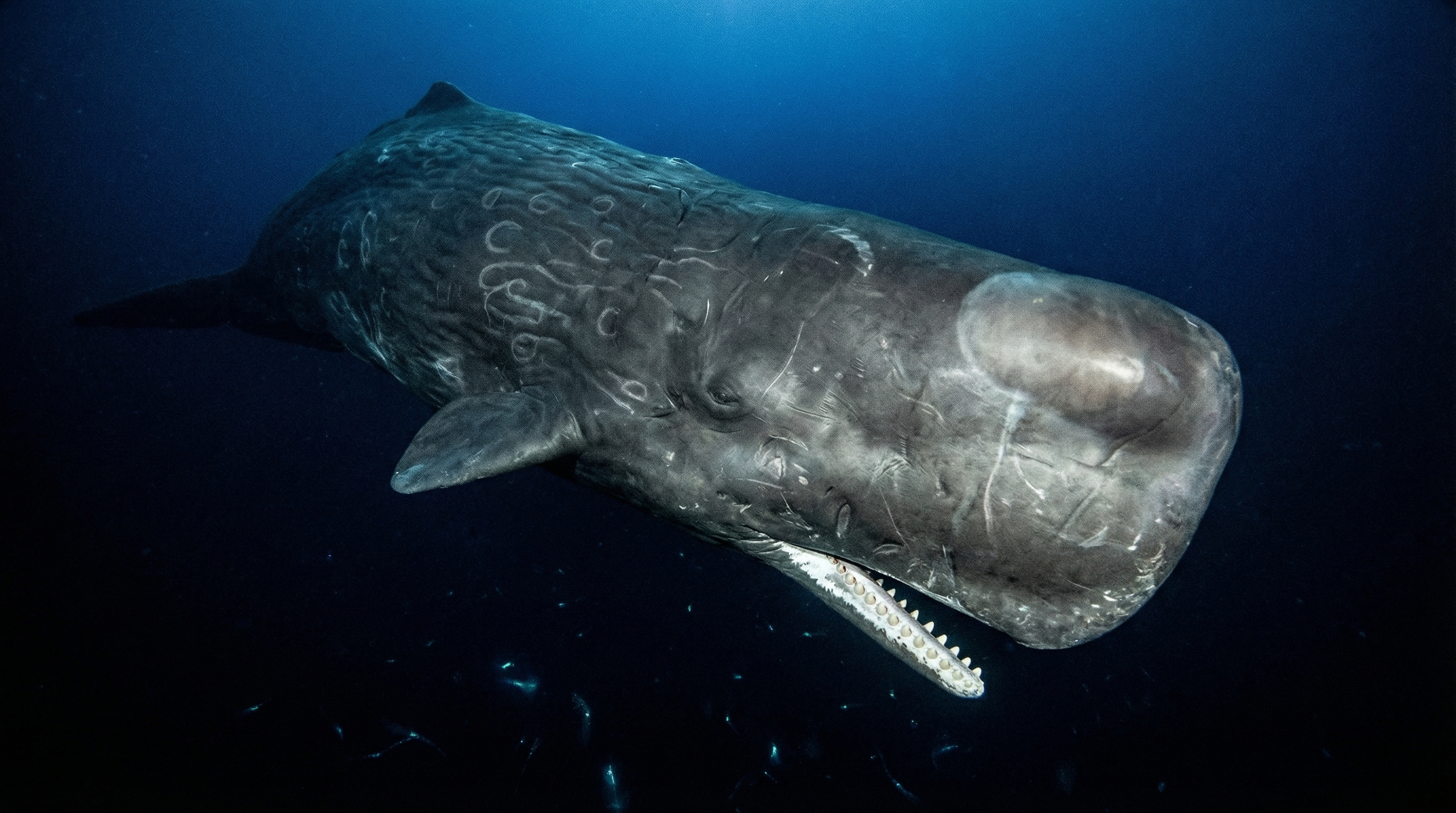
Sperm Whale
Physeter macrocephalus
IUCN: VulnerableAbout Sperm Whale
Sperm whales are the largest toothed predators on Earth and hold the record for the deepest dives of any mammal. They have the largest brain of any animal and are famous for producing ambergris, a valuable substance used in perfumes.
Sperm whales have the largest brain of any animal ever known to exist, weighing about 17 pounds. Their distinctive block-shaped head contains a massive organ filled with spermaceti oil, which helps with buoyancy control and echolocation. They inspired Herman Melville's classic novel 'Moby Dick.'
🌊 Habitat
Sperm whales inhabit deep ocean waters worldwide, from the tropics to the edges of polar ice. They prefer areas over continental slopes and deep ocean canyons where their preferred prey—deep-sea squid—is abundant.
🦐 Diet & Feeding
Sperm whales primarily hunt giant and colossal squid, diving to incredible depths of 1,000-2,000 meters (and possibly deeper) to find them. They also eat various fish and octopus. An adult sperm whale may consume about 1 ton of food per day.
🐋 Behavior
Sperm whales are highly social, living in groups of 15-20 females and young led by a matriarch. Males are more solitary, joining groups only for mating. They use powerful clicks for echolocation—the loudest sounds made by any animal, reaching 230 decibels.
👶 Reproduction
Females give birth to a single calf after a 14-16 month gestation. Calves nurse for 2 years or more and may stay with their mother's group for life (females) or until adolescence (males). Females have calves every 4-6 years.
🛡️ Conservation Status
Sperm whales are listed as Vulnerable. Once heavily hunted for their oil and ambergris, their population was reduced by an estimated 70% during the whaling era. Today, about 300,000 remain worldwide. Threats include ship strikes, entanglement, ocean noise, and plastic pollution.
Fun Facts About Sperm Whale
Sperm whales have the largest brain of any animal—about 17 pounds
Their clicks are the loudest sound made by any animal, reaching 230 decibels
They can dive to depths of 2,000+ meters and hold their breath for over 90 minutes
Sperm whales sleep vertically, bobbing near the surface in groups
They produce ambergris in their intestines, which can be worth thousands per pound