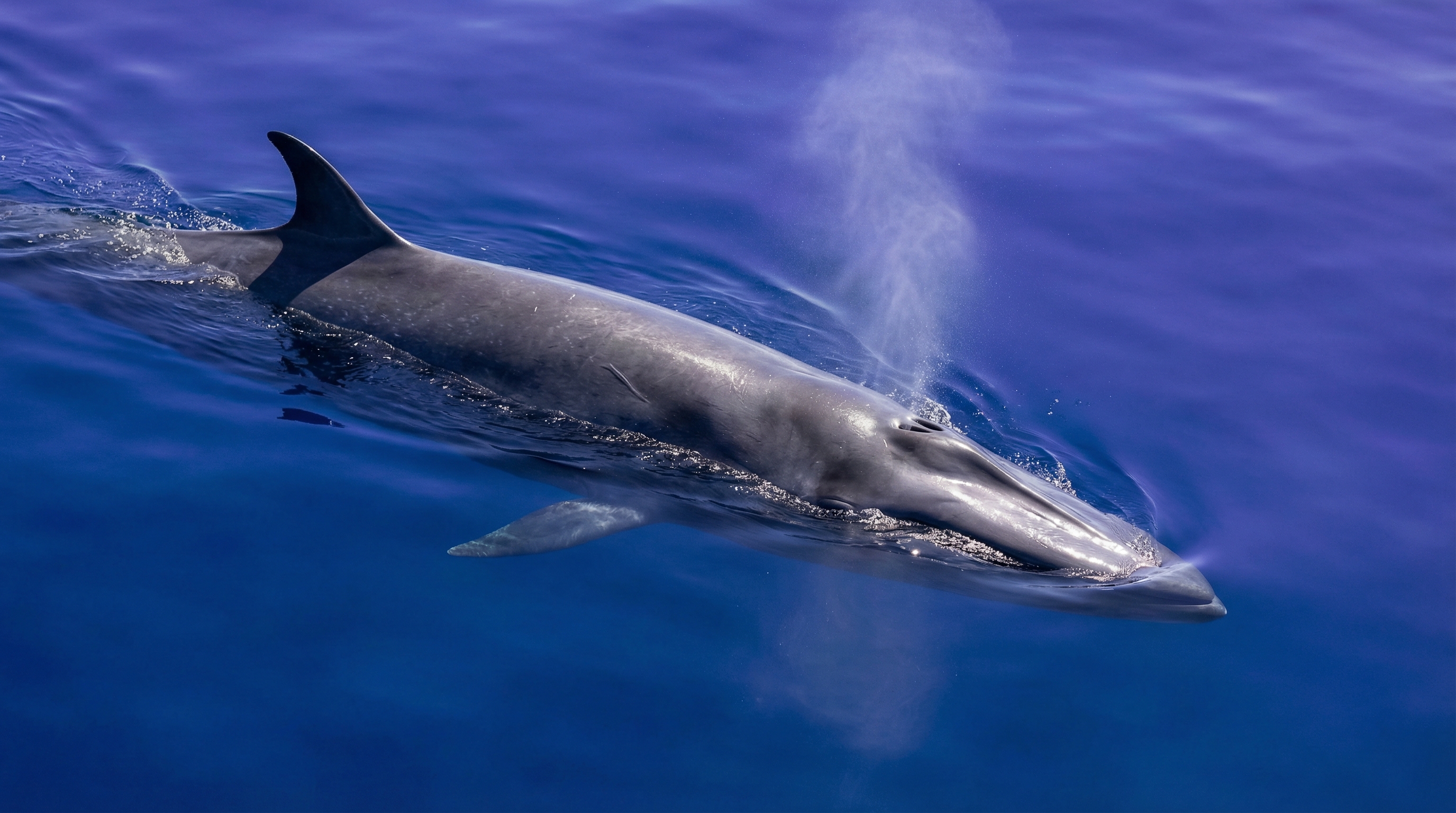
Sei Whale
Balaenoptera borealis
IUCN: EndangeredAbout Sei Whale
Sei whales are among the fastest cetaceans, capable of short bursts of speed up to 31 mph. They are the third-largest baleen whale species after blue and fin whales.
Sei whales are sleek, streamlined baleen whales that can reach lengths of up to 64 feet. They are often confused with Bryde's whales due to similar size and appearance, but can be distinguished by their single prominent rostral ridge compared to Bryde's three ridges.
🌊 Habitat
Sei whales are found in all oceans and adjoining seas, preferring deep offshore waters in temperate zones. They undertake seasonal migrations between cooler feeding grounds in summer and warmer breeding areas in winter, though their patterns are less predictable than other baleen whales.
🦐 Diet & Feeding
Sei whales are versatile feeders that consume copepods, krill, and small schooling fish. Unlike most baleen whales that lunge-feed, sei whales often skim-feed by swimming steadily through patches of prey near the surface with their mouths open, filtering food through their fine baleen plates.
🐋 Behavior
Sei whales are typically found alone or in small groups of 2-5 individuals. They rarely breach and tend to remain near the surface, making shallow dives of 5-20 minutes. They are known for their unpredictable distribution, sometimes appearing in large numbers in an area and then disappearing for years.
👶 Reproduction
Female sei whales give birth to a single calf after an 11-13 month gestation period. Calves are about 15 feet long at birth and nurse for 6-9 months. Sexual maturity is reached at 6-12 years of age.
🛡️ Conservation Status
Sei whales are listed as Endangered on the IUCN Red List. They were heavily hunted during the whaling era, particularly after blue and fin whale populations declined. Current global population is estimated at 50,000-80,000, roughly one-third of pre-whaling numbers.
Fun Facts About Sei Whale
Sei whales can reach speeds of 31 mph in short bursts, making them one of the fastest whales
Their name comes from the Norwegian word 'sei' (pollock), as they often appeared alongside pollock fish
Sei whales have the finest baleen of any whale species, with over 300 plates per side
They can consume up to 2,000 pounds of food per day during peak feeding
Sei whales were the last of the large whales to be targeted by commercial whalers