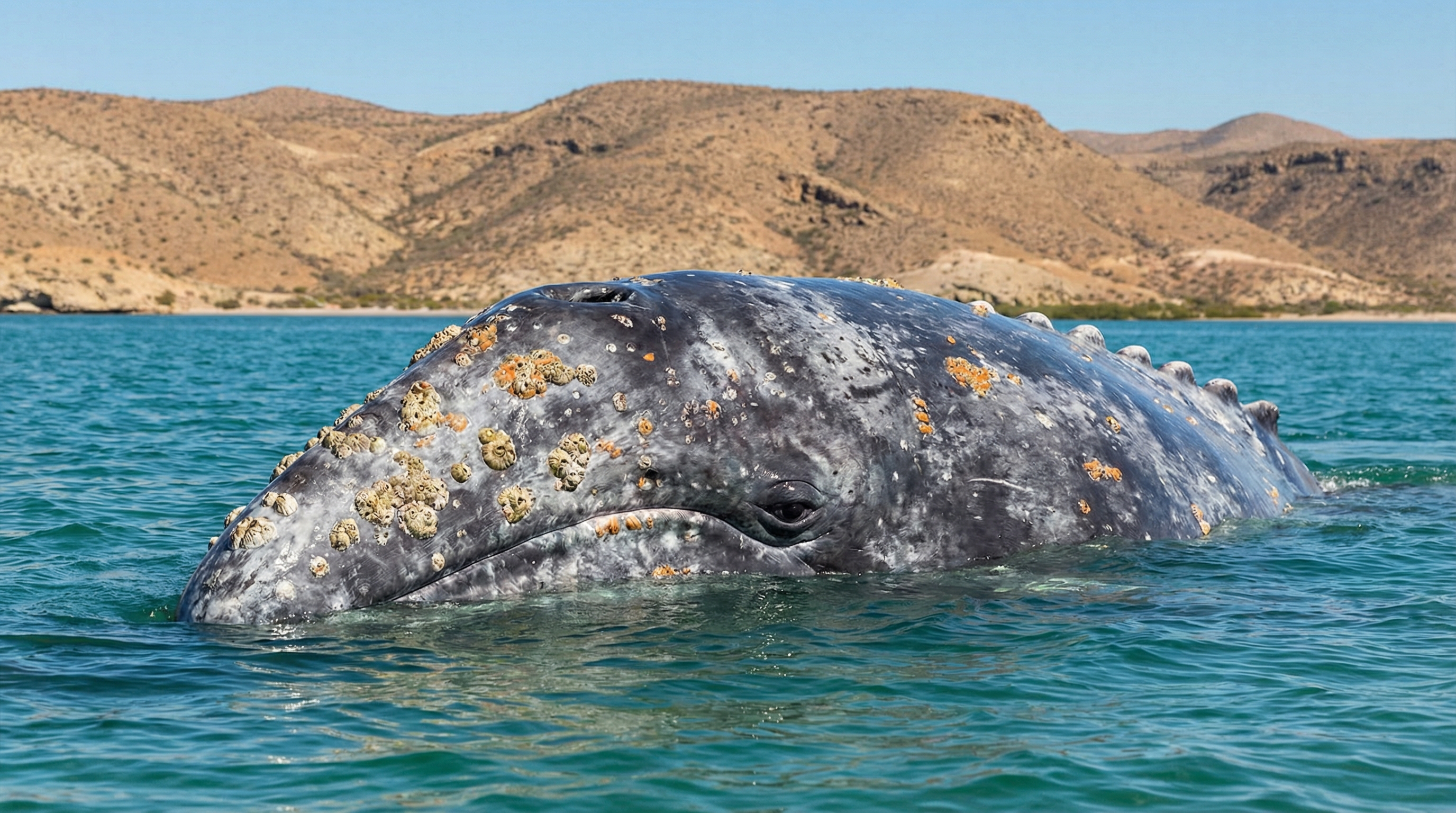
Gray Whale
Eschrichtius robustus
IUCN: Least ConcernAbout Gray Whale
Gray whales are famous for undertaking one of the longest migrations of any mammal, traveling up to 12,000 miles round-trip between their Arctic feeding grounds and Mexican breeding lagoons each year.
Gray whales are medium-sized baleen whales easily identified by their mottled gray coloring and lack of a dorsal fin (they have a series of bumps instead). They're the only living member of their family, Eschrichtiidae, and are considered living fossils.
🌊 Habitat
Eastern Pacific gray whales migrate between summer feeding grounds in the Bering and Chukchi Seas and winter breeding lagoons in Baja California, Mexico. The Western Pacific population (critically endangered) migrates between Russia and South Korea.
🦐 Diet & Feeding
Gray whales are unique among baleen whales in that they're primarily bottom feeders. They roll on their sides and filter sediment to extract amphipods and other small crustaceans. This feeding style leaves visible 'feeding pits' on the ocean floor.
🐋 Behavior
Gray whales are known for their 'friendly whale' behavior in Mexican lagoons, where they often approach boats and allow humans to touch them. During migration, they travel close to shore, making them one of the most accessible whales for observation.
👶 Reproduction
Females give birth to a single calf in the warm, protected waters of Mexican lagoons after a 13-month gestation. Calves are about 15 feet long at birth and nurse for 6-8 months. Mothers and calves migrate north together in spring.
🛡️ Conservation Status
Eastern Pacific gray whales have recovered remarkably from whaling and are listed as Least Concern, with a population of about 20,000. However, the Western Pacific population remains Critically Endangered with perhaps only 150 individuals.
Fun Facts About Gray Whale
Gray whales migrate up to 12,000 miles annually—one of the longest mammal migrations
They're the only bottom-feeding baleen whale, creating 'feeding pits' on the seafloor
In Mexican lagoons, they're famous for approaching boats and seeking human contact
Gray whale calves double their length in the first three months of life
They were once called 'devil fish' by whalers because mothers fiercely defend their calves