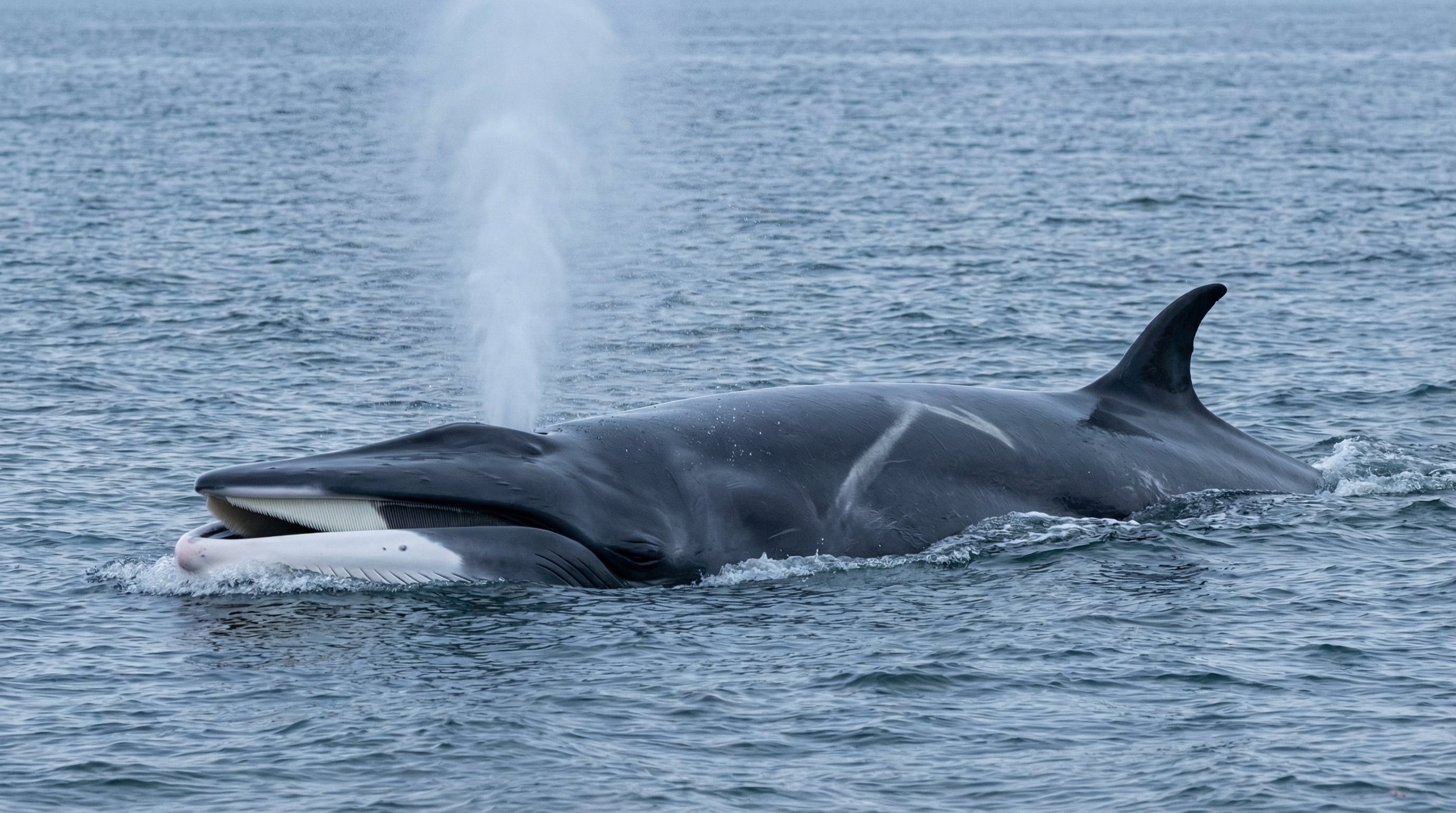
Fin Whale
Balaenoptera physalus
IUCN: VulnerableAbout Fin Whale
The fin whale is the second-largest animal on Earth after the blue whale. Known as the 'greyhound of the sea,' fin whales are the fastest of the great whales, capable of swimming at speeds up to 25 mph.
Fin whales are distinguished by their asymmetrical coloring—the right side of their lower jaw is white while the left side is dark. They're streamlined and built for speed, with a tall, curved dorsal fin positioned far back on their body.
🌊 Habitat
Fin whales are found in all major oceans, from tropical to polar waters. They prefer deep, offshore waters and undertake seasonal migrations, though their patterns are less predictable than other baleen whales.
🦐 Diet & Feeding
Fin whales feed on small schooling fish, squid, and krill. They're lunge feeders, accelerating toward prey concentrations and engulfing huge volumes of water, then filtering out the food through their baleen plates.
🐋 Behavior
Fin whales are usually found alone or in small groups but can aggregate in larger numbers at productive feeding areas. They rarely breach but sometimes surface with their mouths open during feeding. Their low-frequency calls can travel hundreds of miles underwater.
👶 Reproduction
Females give birth to a single calf after an 11-12 month gestation. Calves are about 20 feet long at birth and are weaned at 6-7 months. Sexual maturity is reached at 6-12 years of age.
🛡️ Conservation Status
Fin whales are listed as Vulnerable. Like other great whales, they were heavily hunted—an estimated 750,000 were killed in the Southern Hemisphere alone. Today, populations are recovering, with an estimated 100,000+ worldwide.
Fun Facts About Fin Whale
Fin whales are the second-largest animal on Earth, after the blue whale
They can swim at speeds up to 25 mph, earning the nickname 'greyhound of the sea'
Their coloring is asymmetrical—white on the right jaw, dark on the left
Fin whale vocalizations are among the lowest-frequency sounds made by any animal
They can live up to 90 years